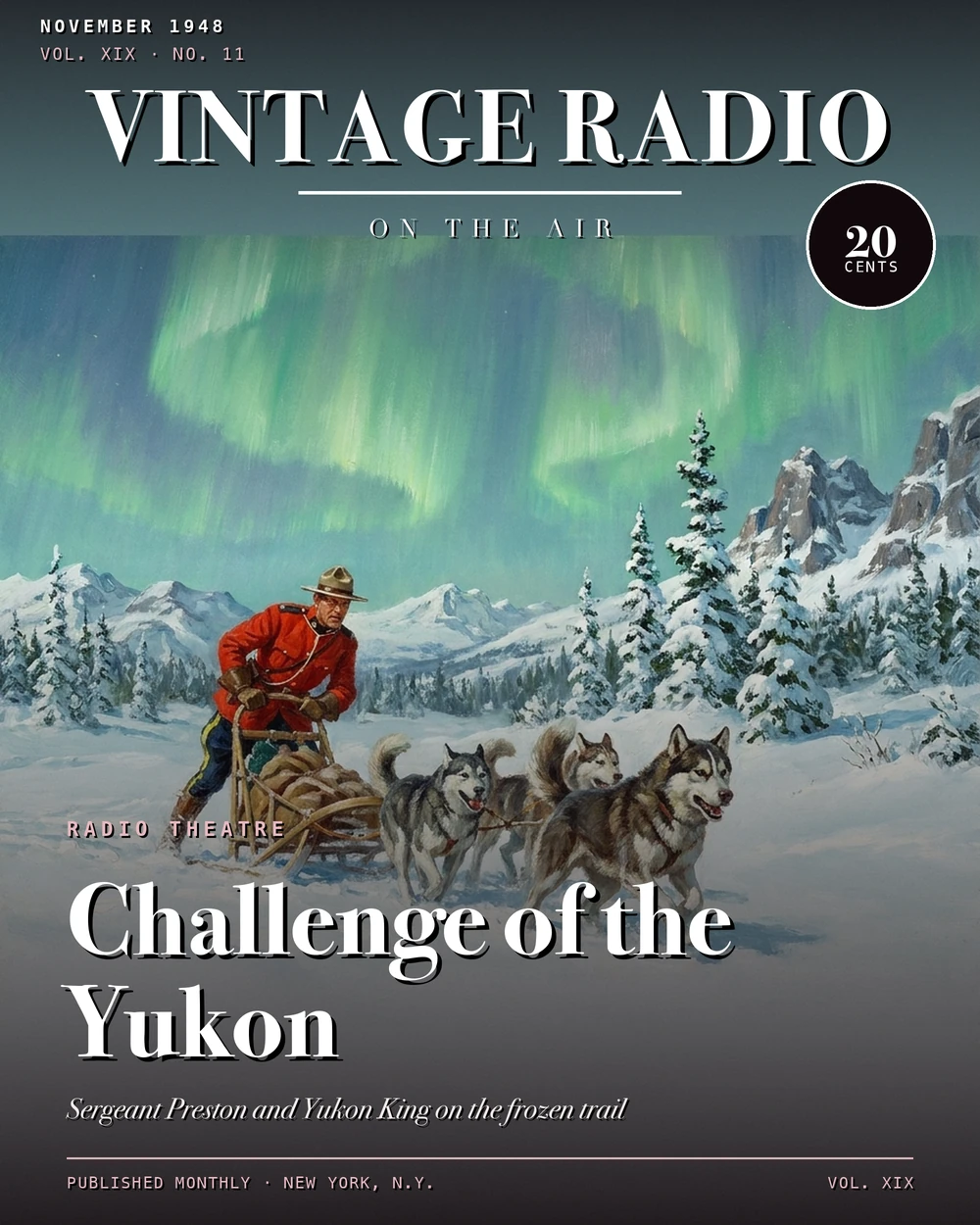
Challenge of The Yukon
The Show That Made a Dog the Hero
George W. Trendle didn't set out to create another hero in the Lone Ranger mold exactly — he set out to build an adventure series around a dog. That was the concept from the start. By 1938, Trendle's Detroit radio operation at WXYZ had already given the country The Lone Ranger and The Green Hornet, and he wanted a third series that would work the same way: simple, vigorous plotting, a larger-than-life hero, lively music pulled from classical compositions. But this time the hero with the most agency in the story would have four legs.
Writer Tom Dougall provided the setting. Dougall had grown up on Robert Service's poems about the frozen north, and he brought that affinity to the script from the beginning. The result was the Yukon — ice, wilderness, dogsled trails, and the early days of the Northwest Mounted Police. Sgt. William Preston became the human anchor of the show, but his Husky, Yukon King, was the one who typically broke the case open. Yukon King mauled bushwhackers, gnawed guns out of villains' hands, and hauled down crooks when the situation called for it. Preston's recurring sign-off said it plainly: "Well, King, thanks to you, this case is closed."
Trendle had been specific about what kind of dog the show needed. In Dick Osgood's memoir of WXYZ, Wyxie Wonderland, Trendle ruled out anything resembling Lassie — this had to be an action story with a working dog. A working dog in the wild days of the Yukon, Trendle concluded, could only be a Husky. The dog character was nearly called Mogo before Trendle's criticism prompted Dougall to rename him King, possibly as a nod to Zane Grey, whose comic King of the Royal Mounted was in circulation at the time and featured a Mountie named King not unlike Preston himself. Preston also had a horse named Rex for the summer months, but it was Yukon King who defined the show's identity.
How It Got on the Air
Challenge of the Yukon first aired on February 3, 1938, on WXYZ in Detroit. When it premiered, it ran five days a week as a 15-minute serial. For nearly a decade it stayed local, mostly on Thursdays in its later WXYZ years, before it ever reached a national audience. According to researcher Terry Salomonson, who compiled detailed broadcast logs for all three of Trendle's major shows, 484 local episodes aired before the series made its network debut. That's a substantial run by any measure, and it gave the show time to find its footing well before anyone outside Detroit heard it.
The network debut came on ABC on June 12, 1947, where the format expanded to 30-minute weekly episodes. Quaker Oats came on as sponsor, and the pairing worked well enough that the cereal company stayed with the show through its entire network life. During 1948 and 1949, the ABC run aired Mondays, Wednesdays, and Fridays at 5 o'clock, putting it squarely in the after-school slot where the audience for juvenile adventure lived.
The show moved to Mutual on January 2, 1950, and kept running there until June 9, 1955, landing in various late-afternoon and weekend timeslots and occasionally airing two or three times a week. In November 1951, during the Mutual years, the show was officially renamed Sergeant Preston of the Yukon — a title that acknowledged what had been apparent to listeners for years, that Preston was the show's human center even if Yukon King was its engine.
The Sound of It
The opening of Challenge of the Yukon was hard to miss. Howling winds, barking dogs, and gunshots — emphasizing almost every word of the opening narration — transported listeners across what the script called "the snow-covered reaches of the wild northwest." It was not subtle, and it wasn't meant to be. Trendle's shows announced themselves with sound, and this one was no exception.
The theme music was The Donna Diana Overture, a piece that became as closely associated with the show as any voice in the cast. The choice fit the Trendle house style: all three of his major juvenile adventure series drew their music from classical compositions, giving them a shared sonic character that set them apart from shows that used original scores or popular songs.
The dog sounds for Yukon King were provided by Dewey Cole in the early years, with Ted Johnstone taking over the barks and whines later in the run. It's a small detail, but it points at how seriously the production took the animal character — someone was hired specifically to make Yukon King sound real, episode after episode, across seventeen years of broadcasting.
Quaker Oats got in on the spirit of the thing with its on-air copy. The sponsor's products, Quaker Puffed Wheat and Quaker Puffed Rice, were described on the air as "the breakfast cereal shot from guns." It was the kind of line that fit the show's whole sensibility.
The Cast Over the Years
Three actors played Sgt. Preston across the run of the show. Jay Michael originated the role from approximately 1938 through the mid-1940s, and when Paul Sutton took over with the 1947 network expansion, Michael stayed on the show as an announcer rather than departing entirely. Sutton carried the bulk of the network years, from roughly the mid-1940s through 1954, covering the ABC run and most of the Mutual period — he came to the role after a Hollywood career playing heavies in B-westerns, including a French trapper in North of the Yukon (1939), a coincidence that proved oddly appropriate given the show's setting. Brace Beemer — better known as the voice of The Lone Ranger from 1941 through that show's end in 1954 — stepped into the role for the final stretch, from 1954 to 1955.
John Todd played Inspector Conrad, Preston's superior officer. Frank Russell played Pierre, the French-Canadian guide who in the early years of the show led Preston on long treks into the northern wilds. Bob Hite served as announcer from 1938 to around 1945, with Jay Michael and later Fred Foy also handling announcing duties at various points. Fred Flowerday directed during the network run.
The writing staff turned over considerably across seventeen years. Tom Dougall launched the show and set its tone. Fran Striker — who had been doing the same work on The Lone Ranger and The Green Hornet — wrote for Challenge of the Yukon from approximately 1942 to 1944. Betty Joyce came in during 1944, followed by Mildred Merrill, Bob Green, Dan Beattie, Felix Holt, Jim Lawrence, and Steve McCarthy at various points over the Mutual years. It was a working production shop, not a one-writer operation, which was typical of how Trendle ran things.
The Trendle Connection
Challenge of the Yukon was the third major juvenile adventure series to emerge from Trendle's Detroit operation and reach the national networks. The Lone Ranger had been on the air since 1933. The Green Hornet launched in 1938, the same year Challenge of the Yukon debuted on WXYZ. All three shows shared the same basic template: a heroic male lead operating just outside ordinary society, a clear moral framework, classical music, and fast-moving plots that kept young listeners engaged.
Many of the same actors and writers moved between the three shows, which gave them a family resemblance in their pacing and sound. Jay Michael, who originated Preston, was a regular supporting villain over on The Lone Ranger; Beemer crossed in the opposite direction at the end. A listener familiar with one Trendle show would have recognized the others immediately — not because they were identical, but because they came from the same production sensibility. The Yukon setting gave Challenge of the Yukon its own distinct atmosphere, colder and more isolated than either the frontier West of The Lone Ranger or the urban world of The Green Hornet, but the underlying construction was the same.
The show ran for seventeen years in total, from its WXYZ premiere in February 1938 to its Mutual finale on June 9, 1955. By the time it ended, the television version — with Dick Simmons as Preston and a purebred Alaskan Malamute as King, shot in color at a reconstructed mining ghost town in Colorado — was already heading toward its September 1955 CBS premiere. The radio audience for juvenile adventure had been shrinking for years. But the run itself — nearly a decade on a local Detroit station, followed by eight years on two national networks — stands as evidence that Trendle's formula held up long past what anyone might have predicted in 1938, when a writer with a fondness for Robert Service poems first imagined a Mountie and his Husky crossing the frozen north.